
Here, you’ll find all eight HYROX exercises, the muscles they work, what to focus on when it comes to technique, and the weights you can expect to use in each category.
| HYROX Exercises: At a Glance How many exercises are there in HYROX? HYROX features eight fixed workout stations in the same order every time, with a 1-kilometre run before each station. Do the weights vary? Yes – at five of the eight stations, depending on the category (Open/Pro) and gender. The SkiErg, rowing and Burpee Broad Jumps are the same for everyone. What is the Roxzone? The transition area between the running course and the workout stations, where you manage transitions and prepare for the next exercise. |
All 8 HYROX Exercises Explained
HYROX combines eight running segments with eight fixed workout stations. The order remains the same at every event worldwide: after each kilometre of running, you complete a functional exercise. For your preparation, this means you need to know not only which exercises to expect, but also how to perform them with proper technique – mistakes can result in invalid repetitions or time penalties.
HYROX Exercise 1: SkiErg

At HYROX, you complete 1,000 metres on the SkiErg.
You pull the two handles of the SkiErg (a Concept2 machine at competitions) down from above, mimicking the movement of cross-country skiing. When performed efficiently, this isn’t just an arm workout – it also engages your core and legs. The resistance is officially preset to level 6, but you can adjust it as you wish. Both feet must remain on the foot platform throughout the exercise. Your heels may extend beyond the edge, but they must not touch the floor.
Muscles worked: Shoulders, back, arms, core and legs.
| Tip: Don’t rely on your arms alone – an efficient movement also uses your hips and legs. Find a steady rhythm early on; pacing your energy is more important than starting fast. |
HYROX Exercise 2: Sled Push

During the Sled Push, you push a loaded sled over 50 metres.
The Sled Push is one of the most physically demanding stations in the entire race, and it overwhelms many athletes who fail to pace themselves properly. Keep your body stable and maintain constant pressure against the floor. Short, controlled steps are often more efficient than frantic pushing – if you start too aggressively, your legs will feel heavy during the next running segment.
Muscles worked: Primarily legs, glutes and core, supported by the upper body and shoulders.
| Tip: How a sled moves depends heavily on the surface, friction and even humidity. A 152 kg sled often feels different in the gym than it does on race day, so don’t rely solely on how it feels in your own training facility. |
HYROX Exercise 3: Sled Pull

During the Sled Pull, you pull a sled over 50 metres using a rope.
You pull the sled backwards using a rope. At the end of each lane, there is a small box approximately 1.7 metres deep that you can step back into. This means the exercise isn’t just about arm strength – it primarily engages your posterior chain (back, glutes and hamstrings). The sled and athlete start behind the line. You pull the sled along the lane, allowing it to pass the line, then move back to the other end and pull again until you’ve completed all 50 metres.
Muscles worked: Back, arms, shoulders, legs and core.
| Tip: Use your whole body instead of pulling with your arms alone. Pay attention to how you manage the rope – the further you pull, the more rope gathers around your feet, creating a tripping hazard. You must remain standing throughout; pulling while sitting or kneeling is not allowed. You can take breaks anywhere along the lane, but leaving your designated lane area at the end results in a time penalty. |
4. HYROX Exercise 4: Burpee Broad Jumps

In the Burpee Broad Jumps, you combine a burpee with a forward broad jump. The race distance is 80 metres.
The official sequence is as follows: place your hands behind the line, lower your chest to the floor, then stand up (by stepping or jumping, without bringing your feet past your hands) and perform a broad jump, taking off and landing with your feet parallel. A maximum offset of 5 centimetres between your feet is allowed – no more. Then return to the starting position, placing your hands no more than 30 centimetres in front of the toes of your front foot, and lower your chest to the floor again. When standing up from the burpee, you may use one knee for support.
Muscles worked: Legs, glutes, core, chest and shoulders.
| Tip: Find a rhythm you can maintain over the entire distance. You don’t need to jump as far as possible every time – a controlled pace saves energy for the upcoming running segments. If you’re just starting out, you can shorten your jumps or incorporate a traditional push-up. |
5. HYROX Exercise 5: Rowing

During the rowing station, also known as Rowing, you complete 1,000 metres on a rowing machine.
You cover the distance on a rowing machine (a Concept2 model at competitions). The resistance (level 6) and footplate position (level 4) are officially preset, but you can adjust both before starting. You must remain seated until you’ve completed the 1,000 metres. You’re allowed to take breaks with your feet on or beside the footplates, but you may only stand up or get off the machine once a judge has confirmed that you can do so.
Muscles worked: Legs, back, shoulders, arms and core.
| Tip: The movement starts with your legs and continues through your hips and upper body before reaching your arms. Don’t be tempted to chase a high stroke rate – powerful, controlled strokes are better than fast, sloppy ones. Saving a few seconds at this station won’t help much if you’re noticeably more tired for the rest of the race. |
6. HYROX Exercise 6: Farmers Carry
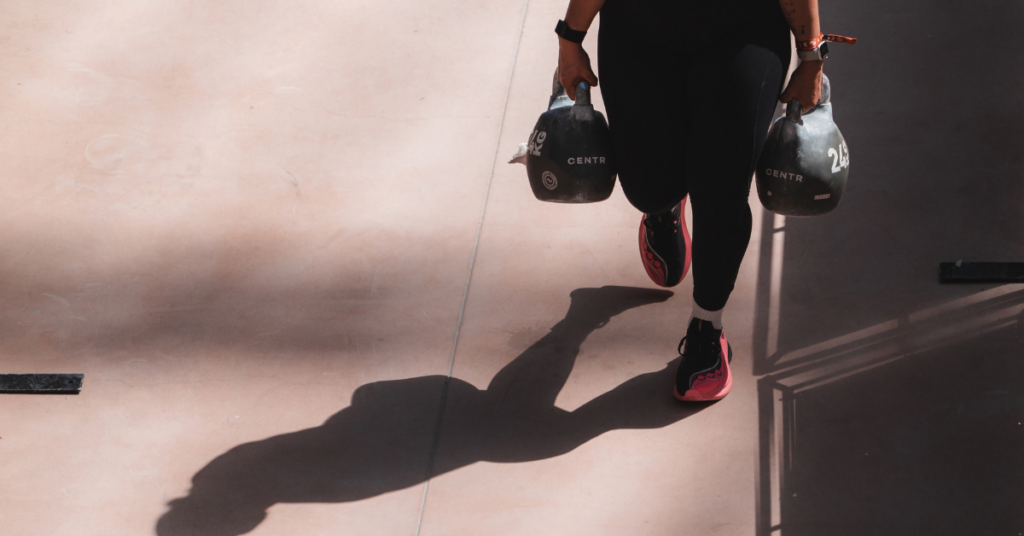
During the Farmers Carry, you carry two kettlebells over 200 metres.
You carry two kettlebells, one in each hand, over the full distance. Your arms must hang straight down by your sides – carrying the weights on your shoulders or with bent arms is not allowed. You can put the weights down as often as needed, as long as they don’t slide forward when you set them down. However, completing the distance without stopping will generally save you time. At the finish, you must return the kettlebells upright and correctly to the marked box, or you’ll receive a time penalty.
Muscles worked: Forearms, grip muscles, shoulders, core and legs.
| Tip: Stay as upright and stable as possible. Don’t train your grip strength alone – your core also needs to stabilise the weights. |
7. HYROX Exercise 7: Sandbag Lunges

During the Sandbag Lunges, you cover 100 metres.
You perform lunges over the full distance with a sandbag resting on both shoulders. Unlike the Farmers Carry, you must not put the sandbag down at any point, and your rear knee must touch the floor with every repetition. You alternate legs and must return to a fully upright position after each lunge before starting the next one – intermediate steps are not allowed. You may pause between repetitions as long as you remain standing with your feet parallel.
Muscles worked: Thighs, glutes and core.
| Tip: Move in a controlled manner and maintain a stable body position. Start by practising without additional weight before increasing the weight of the sandbag. |
8. HYROX Exercise 8: Wall Balls

In competition, you must complete 100 Wall Ball repetitions.
You combine a deep squat with a throw of a medicine ball at a designated target, catch the ball and repeat the movement. If you drop the ball on the floor, however, you must stand fully upright again before the next repetition counts. You’re not allowed to bounce the ball off the floor while jumping and immediately continue with the next repetition. The target height and ball weight vary depending on gender and category (see the table below). This is also the only station where you’re allowed to take off your shoes – closed-toe athletic shoes are mandatory everywhere else during the race.
Muscles worked: Legs, glutes, shoulders and core.
| Tip: Your squat must be deep enough, and the ball must hit the centre of the target. Otherwise, the repetition counts as a “No Rep”, which costs time and adds to your fatigue. Find a rhythm early on: completing 100 repetitions at the end of the race is as much a test of muscular endurance and mental strength as it is of physical strength. |
HYROX Exercises: Official Weights by Category

Five of the eight stations involve additional weight, which varies between the Open and Pro categories and between women and men. The SkiErg, rowing and Burpee Broad Jumps, on the other hand, are the same for everyone – only the distance matters, not the weight.
| Station | Women Open | Women Pro | Men Open | Men Pro |
| Sled Push | 102 kg | 152 kg | 152 kg | 202 kg |
| Sled Pull | 78 kg | 103 kg | 103 kg | 153 kg |
| Farmers Carry (per hand) | 16 kg | 24 kg | 24 kg | 32 kg |
| Sandbag Lunges | 10 kg | 20 kg | 20 kg | 30 kg |
| Wall Ball (weight) | 4 kg | 6 kg | 6 kg | 9 kg |
A helpful rule of thumb: At almost every station, the weights for Women Pro are exactly the same as those for Men Open. Wall Ball target height, however, depends only on gender, not category: women always aim for 2.70 metres, while men always aim for 3 metres. In Doubles, the same weight category applies as in the corresponding individual category. In mixed relays, each person uses the weight specified for their own gender category at the station they complete.
For the Sled Push and Sled Pull, the stated total weight already includes the sled itself – so you add weight to the frame until the total load is reached. The weights are standardised worldwide for every event and are provided on-site, so you don’t need to bring your own equipment.
Why Is Technique So Important in HYROX?

HYROX isn’t simply about going as fast as possible. Each station has official movement standards that specify how the exercise must be performed correctly. Failure to comply can result in invalid repetitions (“No Reps”) or time penalties. This applies to more than just Wall Balls: you must also cover the full Sled distance, Burpee Broad Jumps require a complete burpee and jump movement, and the sandbag generally must not be put down.
That’s why it’s worth practising the movements during training exactly as you’ll need to perform them in competition – rather than attempting them correctly for the first time on race day.
| Practical detail: Chalk Officially, you may only use chalk during the Sled Pull and Farmers Carry. Using it at any other station results in a two-minute penalty. Only chalk provided at the venue is permitted; bringing your own chalk or taking chalk away from the station is also prohibited. |
What Is the Roxzone?
The Roxzone is the transition area between the running course and the workout stations. This is where you move from running to the relevant exercise – and back again. Its size varies from event to event, but on average, you cover around 700 additional metres in the Roxzone over the entire race. That’s more than many athletes expect, and it’s one reason why poorly organised transitions cost valuable time: finding equipment, getting into position at the machine and mentally switching to the next effort.
Practising smooth transitions – for example, moving quickly from running to the SkiErg or sled without slowing down unnecessarily or getting lost – is therefore just as important as training the individual stations themselves. One practical detail: every Roxzone has a designated IN and OUT arch. Using the wrong arch to enter or exit results in a two-minute penalty, so it’s worth familiarising yourself with the layout before race day.
How Do I Train for HYROX Exercises?

You don’t have to complete all eight stations in every training session. Instead, you can focus on specific areas:
Strength: Sled Push + Sled Pull + Farmers Carry
Legs: Lunges + Wall Balls
Endurance: SkiErg + Rowing
Conditioning: Burpee Broad Jumps + Running
Later on, you can combine the exercises with running segments to practise the transitions that make HYROX so distinctive – for example:
| Example Combination 1 km run → SkiErg → 1 km run → Sled Push |
This type of training under pre-fatigue – also known as “compromised running” – is one of the most important elements of preparation. By the second or third running segment, your legs are no longer fresh, and your training should prepare you for exactly that challenge, rather than focusing only on individual stations or long runs without prior exertion.
The eight HYROX exercises are deliberately varied: strength, endurance, grip and leg strength all play a role. Understanding which muscles each station challenges and what the official standards require helps you train more effectively instead of being caught off guard by individual stations during the race.
With your Urban Sports Club membership, you can find studios and training classes offering HYROX and Functional Fitness in various cities, right near you.
- Discover HYROX and Functional Fitness classes in Berlin
- Discover HYROX and Functional Fitness classes in Munich
- Discover HYROX and Functional Fitness classes in Hamburg
- Discover HYROX and Functional Fitness classes in Cologne
- Discover HYROX and Functional Fitness classes in Düsseldorf
Frequently Asked Questions About HYROX Exercises
Which HYROX stations don’t involve additional weight?
The SkiErg, rowing and Burpee Broad Jumps are the same across all categories and genders – only the specified distance matters, not the weight.
What does “No Rep” mean in HYROX?
A repetition or section that doesn’t meet the official movement standards – for example, a squat that isn’t deep enough or a missed target during Wall Balls. A “No Rep” generally has to be repeated correctly.
Do I need to train with different weights for Doubles or Relay?
No – the weights depend on your category (Open or Pro) and gender, not on the team format. In Doubles, the team simply divides the stations between the two athletes; the weight itself doesn’t change.
How can I train if I don’t have access to all the equipment yet?
Many stations can be simulated using alternatives: a barbell press instead of a sled, a heavy backpack instead of a sandbag, and kettlebells or dumbbells instead of the official Farmers Carry weights. The movement patterns are more important than having the exact equipment used in competition.


